
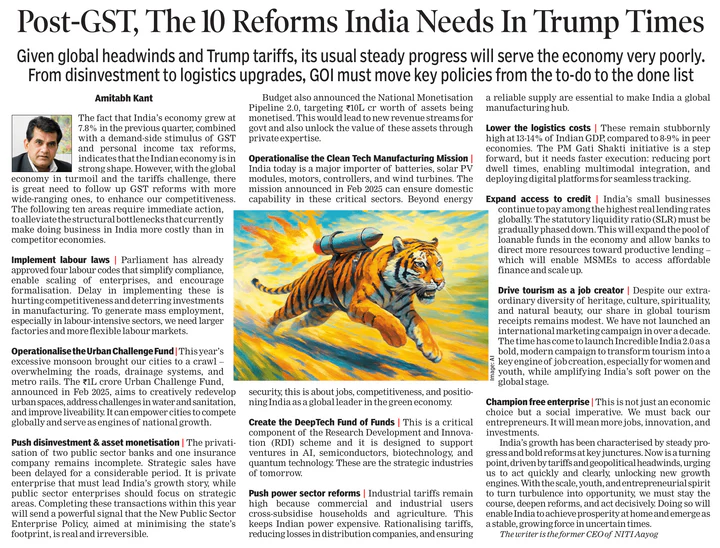
GST reforms should trigger the movement for wide-ranging reforms that enhance India's competitiveness.
Mr. Amitabh Kant
On Wednesday, 3rd September, the landmark reforms in the Goods and Services Tax (GST) simplified the rate structure and made most household goods, whether fast-moving or durable, more affordable. As consumption rises, capacity utilisation increases. An increase in capacity utilisation triggers fresh investments, creating jobs and growth. More jobs and growth further boost consumption, and a virtuous cycle of investment, job creation and growth ensues. This is precisely what the GST and personal income tax reforms will achieve. GST reforms, combined with the personal income tax stimulus, will significantly boost domestic demand. The fact that the economy grew at 7.8% in the previous quarter, combined with a demand-side stimulus, indicates that the Indian economy is in strong shape.
However, today, the global economy is in turmoil. This turbulence is a reminder that no country can take global markets for granted. These tariffs have presented us with a significant opportunity. GST reforms should trigger the movement for wide-ranging reforms that will enhance our competitiveness. I have identified the following 10 areas where immediate action is required. Addressing these areas will alleviate the structural bottlenecks that currently make doing business in India more costly than in competitor economies.
Implementing Labour Laws
Parliament has already approved four labour codes that simplify compliance, enable scaling of enterprises, and encourage formalisation. Yet their implementation has been delayed. This hesitation hurts competitiveness and deters investment in manufacturing. To generate mass employment, especially in labour-intensive sectors, we need larger factories and more flexible labour markets. Reform delayed is reform denied.
Instituting the Urban Challenge Fund
This year’s excessive monsoon brought our cities to a crawl: flooded roads, overwhelmed drainage systems, overcrowded metro rails. The ₹1 lakh crore Urban Challenge Fund, announced in February 2025, seeks to position cities as drivers of growth. It aims to creatively redevelop urban spaces, address challenges in water and sanitation, and improve liveability. Operationalising this fund can empower cities to compete globally and serve as engines of national growth.
Pushing Disinvestment and Asset Monetisation
The privatisation of two public sector banks and one insurance company remains incomplete. Strategic sales have been delayed for a considerable period. It is private enterprise that must lead India's growth story, while public sector enterprises should focus on strategic areas. Completing these transactions within this year will send a powerful signal that the New Public Sector Enterprise Policy, aimed at minimising the state’s footprint, is real and irreversible.
The Budget also announced the National Monetisation Pipeline 2.0, targeting ₹10 lakh crore worth of assets being monetised. As we know, monetising assets can lead to new revenue streams for the government and also unlock the value of these assets through private expertise.
Operationalising the Clean Tech Manufacturing Mission
India today is a major importer of batteries, solar PV modules, motors, controllers, and wind turbines. This dependency is unsustainable. The Clean Tech Manufacturing Mission, announced in February 2025, can ensure domestic capability in these critical sectors. This is not just about energy security. It is about jobs, competitiveness, and positioning India as a global leader in the green economy. We cannot afford delays.
Creating the DeepTech Fund of Funds
A critical component of the RDI scheme is the creation of the DeepTech Fund of Funds, designed to support ventures in AI, semiconductors, biotechnology, and quantum technology. These are the strategic industries of tomorrow. If India is to compete with global leaders, this fund must be activated immediately.
Pushing Power Sector Reforms
Industrial tariffs remain high because commercial and industrial users cross-subsidise households and agriculture. This keeps Indian power expensive and erodes competitiveness. The time has come to bite the bullet.
Rationalising tariffs, reducing losses in distribution companies, and ensuring a reliable supply are essential to make India a global manufacturing hub.
Lowering the Cost of Logistics
India’s logistics costs remain stubbornly high at 13–14 per cent of GDP, compared to 8–9 per cent in peer economies. The PM Gati Shakti initiative is a step forward, but it needs faster execution: reducing port dwell times, enabling multimodal integration, and deploying digital platforms for seamless tracking. The target of cutting logistics costs to 8–9 per cent must be pursued with urgency.
Expanding Access to Credit
India’s small businesses continue to pay among the highest real lending rates globally. The statutory liquidity ratio (SLR) must be gradually phased down. This will expand the pool of loanable funds in the economy, allowing banks to direct more resources toward productive lending. This will reduce the cost of credit, enabling MSMEs to access affordable finance and scale up.
Driving Tourism as a Job Creator
India must tap into its vast, untapped tourism potential. Despite our extraordinary diversity of heritage, culture, spirituality, and natural beauty, our share in global tourism receipts remains modest. We have not launched an international marketing campaign in over a decade. The time has come to launch Incredible India 2.0, a bold, modern campaign that positions India as a top global destination. We must transform tourism into one of the most significant engines of job creation, especially for women and youth, while amplifying India’s soft power on the global stage.
Championing Free Enterprise
Free enterprise drives growth, innovation, and job creation. We must back our entrepreneurs. Free enterprise is not just an economic choice but a social imperative. This means more jobs, innovation, and investments.
India’s growth has been characterised by steady progress and bold reforms at key junctures. Now is a turning point, driven by tariffs and geopolitical headwinds, urging us to act quickly and clearly. By advancing disinvestment, asset monetisation, operationalising the Urban Challenge Fund, promoting clean-tech manufacturing, implementing labour codes, and revitalising tourism through Incredible India 2.0, we can unlock new growth engines. Lowering costs of power, logistics, and credit will boost India’s global competitiveness. With the scale, youth, and entrepreneurial spirit to turn turbulence into opportunity, we must stay the course, deepen reforms, and act decisively. Doing so will enable India to achieve prosperity at home and emerge as a stable, growing force in uncertain times.
The author was India’s G20 Sherpa and is the former CEO of NITI Aayog.